Puraiva / Blog / Adaptogens
Maca Root vs. Ashwagandha: Which Adaptogen Is Right for Your Hormones and Cortisol?
A practical, science-backed comparison of maca and ashwagandha for cortisol regulation, hormone balance, energy, libido, and sleep — with stacking guidance.
By Dr. Sarah Mitchell · · 14 min read
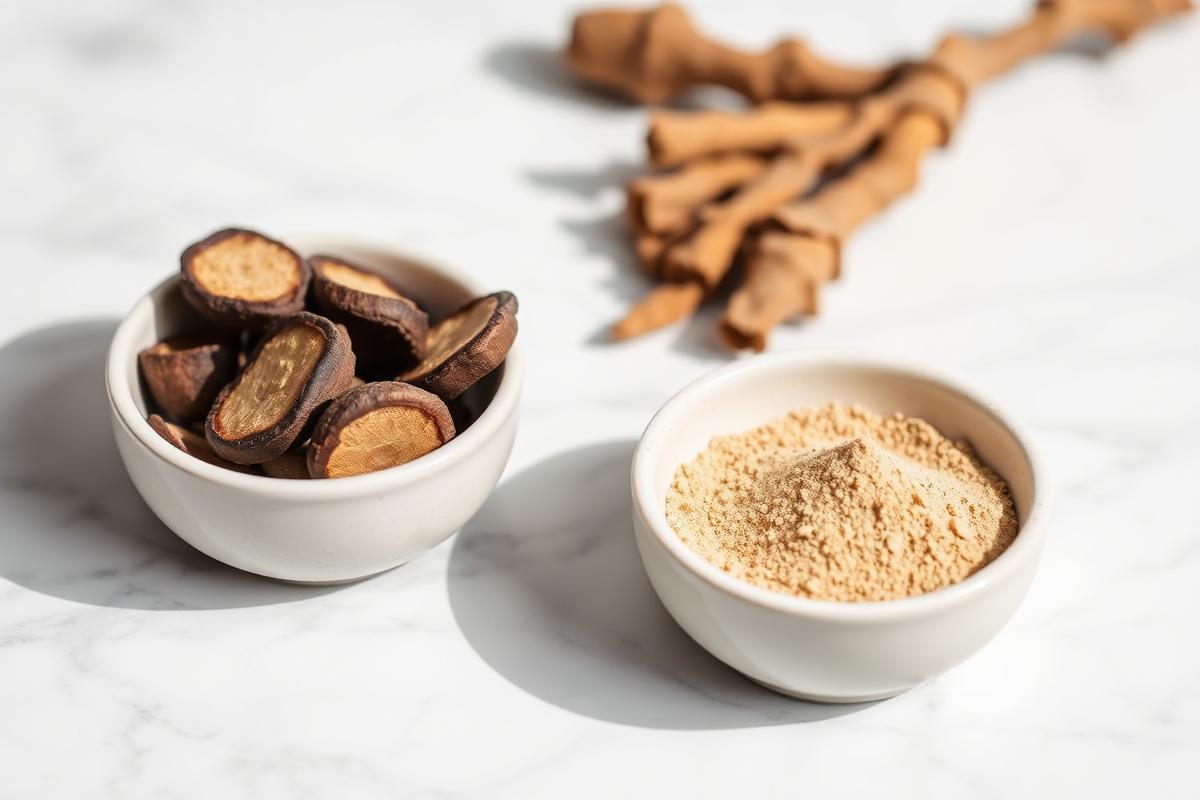
Maca root and ashwagandha are the two most-searched adaptogens for hormone health — and they keep getting compared because, on the surface, they sound similar: both are billed as "stress-balancing," both promise more energy, both show up in every "natural cortisol support" article on the internet.
But pharmacologically, they're almost opposites. Choosing the wrong one is one of the most common reasons people give up on adaptogens after 30 days saying "it didn't work." This guide cuts through that — exactly what each does, the cortisol-specific evidence, and a simple decision framework for which (or both) belongs in your stack.
Quick answer: Ashwagandha lowers a cortisol curve that's running too high. Maca doesn't directly lower cortisol — it restores energy, libido, and mood when chronic stress has already drained you. They solve different stages of the same problem, which is why a lot of people quietly do best on both. → Take the 2-minute Cortisol Profile Quiz to see which stage you're in.
What Each Adaptogen Actually Is
Ashwagandha (Withania somnifera)
Ashwagandha is a small evergreen shrub from India, used in Ayurveda for over 3,000 years. The root contains withanolides — steroidal lactones that interact with the HPA axis (hypothalamic-pituitary-adrenal axis), the master regulator of your cortisol output. The most clinically-studied extract is KSM-66, a full-spectrum root extract standardized to 5% withanolides, used in the majority of published cortisol trials.
Maca Root (Lepidium meyenii)
Maca is a cruciferous root vegetable grown above 4,000 meters in the Peruvian Andes — one of the only crops that thrives in that extreme environment. It's been used for at least 2,000 years as both a food and a tonic for fertility, stamina, and resilience to altitude. Maca's active compounds are macamides, macaenes, glucosinolates, and sterols — none of which directly bind hormone receptors. Instead, maca works upstream by supporting the hypothalamus and pituitary, which then regulate downstream sex hormones.
This distinction matters. Maca is technically classified as an adaptogen and a "hormone modulator" — but it does not contain phytoestrogens. It doesn't add hormones to your system; it nudges your own production back toward baseline.
Mechanism Comparison: Same Goal, Different Pathways
| Mechanism | Ashwagandha | Maca |
|---|---|---|
| Acts on cortisol directly? | Yes — lowers serum cortisol 14–28% in 60 days | No direct cortisol effect |
| HPA axis effect | Down-regulates over-active axis | Supports hypothalamic–pituitary signaling |
| Sex hormone effect | Indirect (via cortisol/DHEA balance) | Indirect (via HPG axis modulation) |
| Best stress phase | Wired & tired, high cortisol, racing mind at night | Burned out, flat, low libido, low motivation |
| Energy effect | Calm energy — removes the brake | Active energy — pushes the gas |
| Best taken | Evening (or AM + PM) | Morning or early afternoon |
| Onset | 4–8 weeks for cortisol metrics | 2–6 weeks for energy/libido |
What the Clinical Evidence Actually Shows
Ashwagandha for Cortisol — The Strongest Adaptogen Trial Data
Ashwagandha has the deepest human trial record of any adaptogen for cortisol specifically:
- A landmark 2012 trial in the Indian Journal of Psychological Medicine (Chandrasekhar et al.) using 600 mg/day of KSM-66 for 60 days showed a 27.9% reduction in serum cortisol versus 7.9% with placebo, plus significant improvements on the Perceived Stress Scale.
- A 2019 trial in Medicine (Baltimore) using 240 mg/day of a standardized extract for 60 days showed a 23% reduction in morning cortisol and reduced anxiety scores.
- A 2019 sleep trial in Cureus (Langade et al.) using 300 mg twice daily for 10 weeks improved sleep onset latency, total sleep time, and sleep efficiency in adults with insomnia.
- Multiple smaller trials show modest improvements in testosterone, DHEA-S, and thyroid markers — most of these appear to be downstream of the cortisol effect, not direct hormonal action.
Maca for Energy, Mood, and Libido — Strongest for "Burnout" Symptoms
Maca has fewer cortisol trials and a different focus:
- A 2008 trial in Menopause using 3.5 g/day of gelatinized maca for 6 weeks showed significant improvements in psychological symptoms (anxiety, depression scores) and sexual dysfunction in postmenopausal women — without changes to estrogen, FSH, or LH. The mechanism appears upstream.
- A 2002 trial in Andrologia using 1.5–3 g/day for 12 weeks in men showed improved sexual desire independent of testosterone changes.
- A 2009 trial in the Journal of Ethnopharmacology using 2 g/day for 14 days in athletes improved endurance and time-trial performance.
- Maca shows neuroprotective and antioxidant effects in animal models, and small human trials suggest improved mood scores — particularly in people with low baseline energy.
The pattern is clear: ashwagandha's trial weight is on stress chemistry. Maca's is on the symptoms that show up after chronic stress has worn the system down.
Which Should You Choose? A Decision Framework
The single best predictor of which adaptogen will work for you isn't your gender or your age — it's where you are in the cortisol curve. Two people with the same "I'm stressed and tired" complaint can need opposite tools.
Choose Ashwagandha If…
- You feel "wired and tired" — exhausted but can't switch off
- You have a racing mind at night, especially 2–4 AM wakeups
- You hold tension in your jaw or shoulders
- You're irritable, reactive, or short-tempered under load
- You crash hard in the afternoon but get a second wind at 10 PM
- You suspect your cortisol curve is too high or inverted
Ashwagandha is your match. Start with AshwaVital (KSM-66) at 600 mg/day with dinner for 8 weeks before evaluating.
Choose Maca If…
- You feel flat — not anxious, just nothing in the tank
- Your libido has dropped and you no longer care that it has
- You wake unrefreshed regardless of how long you sleep
- You've already done the cortisol work (sleep, magnesium, ashwagandha) and feel calmer but still depleted
- You're navigating perimenopause, postpartum recovery, or post-pill rebalancing
- You're an athlete or shift worker dealing with chronic recovery debt
Maca is your match. Start with TriMaca Boost (red, yellow, black gelatinized blend) at 1.5–3 g with breakfast.
Take Both If…
- You recognize symptoms from both lists
- You've cycled through the "wired" phase into the "flat" phase
- You're in the second half of a recovery protocol and want to rebuild after stabilizing
The stack is covered in detail below.
Maca vs. Ashwagandha for Women
The most common comparison is for women navigating hormonal change — PMS, perimenopause, postpartum, post-pill — where stress and sex hormones are simultaneously off.
Ashwagandha for Women
Ashwagandha is most useful for women whose primary symptom is the cortisol overlay — sleep disruption, anxiety, irritability, jaw tension, "tired but wired." A 2021 randomized trial in The Journal of Obstetrics and Gynaecology Research showed ashwagandha (300 mg twice daily) improved perimenopausal symptom scores and reduced cortisol over 8 weeks. It's particularly helpful for women whose anxiety has crept up over the last 1–3 years and whose sleep got noticeably worse during the same window.
Note: women on thyroid medication should monitor closely with their clinician, as ashwagandha can mildly increase thyroid hormone output.
Maca for Women
Maca is most useful when the cortisol storm has passed (or never was the main issue) and the dominant symptoms are fatigue, low mood, and absent libido. The 2008 Menopause trial and a 2015 trial in Climacteric both showed improvements in mood and sexual function for peri- and postmenopausal women — without measurable changes to estrogen, progesterone, FSH, or LH. That last point matters: maca does not appear to be estrogenic, which is why it's generally considered safe for women with a history of hormone-sensitive concerns (always confirm with your clinician).
For women dealing with classic peri symptoms — disrupted sleep AND fatigue AND low libido — the answer is usually both. Ashwagandha handles the cortisol and sleep; maca handles the recovery side. See the stacking section below.
Maca vs. Ashwagandha for Men
Ashwagandha for Men
For men, ashwagandha has the better-controlled testosterone data. A 2019 trial in the American Journal of Men's Health using 600 mg/day of KSM-66 for 16 weeks showed an ~15% increase in total testosterone and ~18% increase in DHEA-S in overweight men aged 40–70. A 2015 strength-training trial showed similar testosterone improvements and meaningful gains in muscle mass and strength.
The simplest framing: ashwagandha increases the testosterone you should already be making by removing the cortisol brake on it. If chronic stress is suppressing your output, ashwagandha helps. If your output is structurally low for other reasons, it does less.
Maca for Men
Maca improves libido and erectile function in men without reliably moving serum testosterone — the effect is mediated centrally (brain/HPG axis) rather than gonadally. Multiple trials (notably the 2002 Andrologia study) show this dissociation clearly. For a man whose testosterone is fine on paper but whose drive and energy aren't, maca often outperforms ashwagandha. For men with classic high-cortisol burnout, ashwagandha is the better lever.
How to Stack Them (and Why Many People End Up On Both)
Maca and ashwagandha are not competitive — they sit at different points on the recovery arc. The most common evidence-based stack:
The Diagnose → Correct → Rebuild Sequence
- Weeks 1–8 (Correct): Ashwagandha (KSM-66) 600 mg with dinner + magnesium glycinate 300–400 mg before bed. This phase brings the cortisol curve down, restores sleep, and reduces the tension layer.
- Weeks 4–12 (Rebuild — overlap with phase 1): Add maca 1.5–3 g with breakfast. As cortisol normalizes, maca's energy and libido effects become noticeable (they're often masked when cortisol is still spiking).
- Maintenance: Continue both, or cycle maca 5 days on / 2 off and keep ashwagandha continuous. Re-evaluate at 90 days.
This sequence is the basis of the Puraiva Recovery Trinity stack — ashwagandha calms the system so maca has something stable to build on.
Timing Matters
- Ashwagandha at night. It's mildly sedating for most people and lines up with the natural cortisol dip — taking it in the morning can blunt the cortisol awakening response some people actually need.
- Maca with breakfast. Its energizing effect is mild but real; taking it after 2 PM can disrupt sleep onset for sensitive individuals.
- Take maca with food. Gelatinized maca digests cleanly; raw maca is harder on the gut.
Side Effects and Who Should Be Cautious
Ashwagandha — Cautions
- Mild GI upset or loose stool in the first week (usually resolves)
- Can be over-sedating at high doses — start at 300 mg and titrate up
- Use caution if on thyroid medication, immunosuppressants, or sedatives
- Generally avoided in pregnancy and active hyperthyroid conditions
- People with autoimmune conditions should consult their clinician
Maca — Cautions
- Choose gelatinized maca (heat-treated to remove starch and improve digestibility); raw maca contains goitrogens that may affect thyroid in sensitive individuals
- Can be too stimulating for highly anxious states — don't lead with maca if you're already wired
- Hormone-sensitive conditions: data suggests no direct hormonal action, but confirm with your clinician
- Stop 2 weeks before scheduled surgery (mild platelet effects in animal data)
What to Look For in a Quality Product
Ashwagandha Quality Checklist
- KSM-66 or Sensoril: the two extracts with the bulk of human trial data
- Standardized to ≥5% withanolides (KSM-66) or 10% (Sensoril)
- Full-spectrum root only — leaf-inclusive extracts are cheaper but not the studied form
- Third-party tested for heavy metals — root crops accumulate lead and arsenic
- Organic certification when possible
Maca Quality Checklist
- Peruvian origin, above 4,000 m elevation — non-Peruvian maca lacks the same alkaloid profile
- Gelatinized, not raw — for digestion and bioavailability
- Tri-color (red + yellow + black) — each color has a different macamide and sterol profile, and the blend covers more endpoints than any single color
- Organic and third-party tested for heavy metals (especially cadmium, which Andean soils can contain)
- No fillers or "maca extract" without specified ratios
Puraiva's AshwaVital uses standardized KSM-66 root extract; TriMaca Boost is a gelatinized tri-color Peruvian blend. Both are third-party tested for heavy metals and microbials.
The 30-Day Self-Test
If you're genuinely unsure which to start with, a simple structured trial is the fastest answer. Most people get a clearer signal from a 30-day run than from any blog comparison (this one included).
- Pick one based on the decision framework above. If you can't decide, default to ashwagandha — cortisol comes before recovery.
- Track three numbers daily: sleep quality (1–10), morning energy (1–10), and stress reactivity (1–10).
- Hold all other variables steady — caffeine, training, sleep window — for the 30 days.
- Re-score on day 30. A meaningful response is a ≥2-point shift on at least two metrics. If you got it, continue and consider adding the second adaptogen. If you didn't, switch to the other one for the next 30 days.
For a structured version of this with type-matched protocols, the free Cortisol Profile Quiz sorts you into one of four phenotypes and returns a 90-day stack — most people land in either the Wired & Tired (ashwagandha-led) or Burned Out (maca-led) protocol.
Frequently Asked Questions
Can I take maca and ashwagandha together every day?
Yes. They have different mechanisms and no documented interaction. The standard pairing is ashwagandha at dinner and maca with breakfast. Most people do best holding this stack for at least 90 days before evaluating.
Which works faster?
Maca's energy and mood effects often show up in 2–3 weeks. Ashwagandha's cortisol and sleep effects typically take 4–8 weeks to reach the magnitudes seen in clinical trials. Don't quit either before week 6.
Does maca raise cortisol?
Maca does not appear to directly raise or lower cortisol in human trials. It is energizing for some people, but the effect is mediated through hypothalamic and dopaminergic pathways rather than the cortisol axis. Highly anxious individuals sometimes report it feels stimulating — in that case, lower the dose or address cortisol first.
Does ashwagandha lower testosterone or estrogen?
No. Ashwagandha tends to raise testosterone modestly in men with stress-suppressed levels and has no consistent estrogen-lowering effect in women. The hormonal changes are downstream of cortisol reduction, not direct.
Can I take maca during pregnancy or breastfeeding?
Maca has a long traditional history as a food in Peru, but rigorous safety data in pregnancy and lactation is limited. Default to discontinuing during pregnancy and breastfeeding unless your clinician advises otherwise. Same applies to ashwagandha — it's typically avoided in pregnancy.
I'm on thyroid medication. Which is safer?
Maca is generally the safer default if you're on thyroid replacement, provided you choose gelatinized (not raw) maca. Ashwagandha can mildly raise T3/T4, which is fine for most but can require a dose adjustment for those on levothyroxine. Coordinate with your prescriber.
Will either help with weight management?
Indirectly. Ashwagandha can reduce stress-driven eating and improve sleep, both of which support healthy body composition. Maca can restore the energy needed to train consistently. Neither is a weight-loss supplement.
Which is better for libido?
Maca has more direct evidence for libido in both men and women, independent of sex-hormone changes. Ashwagandha helps libido when low libido is a downstream symptom of stress and poor sleep — which it often is. If the problem is purely drive, start with maca. If it's stress with low drive as a symptom, start with ashwagandha.
The Bottom Line
Ashwagandha and maca aren't interchangeable adaptogens you pick on vibes. They solve different stages of the same problem:
- Ashwagandha is the brake — it brings an over-active stress response back down.
- Maca is the rebuild — it restores energy, mood, and drive once the system has been allowed to settle.
For most people in the middle of a chronic-stress chapter, the right answer is both, in sequence: ashwagandha first to stabilize the cortisol curve, maca added at week 4 to start rebuilding what stress has drained. Quality, dosing, and timing matter more than brand loyalty — pick a clinically-studied extract, take it daily for at least 8 weeks, and track three honest numbers so you know what's actually working.
→ Not sure which stage you're in? The free 2-minute Cortisol Profile Quiz sorts you into one of four phenotypes and returns a type-matched 90-day stack built around these two adaptogens plus magnesium glycinate.
These statements have not been evaluated by the Food and Drug Administration. These products are not intended to diagnose, treat, cure, or prevent any disease. Consult your healthcare provider before starting any new supplement, especially if you are pregnant, breastfeeding, taking medication, or managing a chronic condition.