Puraiva / Blog / Cortisol & Stress
How to Lower Cortisol Levels Naturally: The Complete 2026 Guide
A science-backed, step-by-step guide to lowering cortisol — the lifestyle changes, foods, and specific supplements (including which magnesium form actually works) that bring stress hormones back to baseline.
By Dr. Sarah Mitchell · · 14 min read
If you feel tired but wired, wake up between 2–4 AM with a racing mind, or notice stubborn belly fat that won't budge no matter how clean you eat — cortisol is almost certainly involved. Cortisol is your body's primary stress hormone, and when it stays elevated for weeks or months at a time, it silently rewires your sleep, metabolism, mood, and immune system.
This is the pillar guide in our Cortisol & Stress Recovery hub. Go deeper with the anti-cortisol diet and the evidence-based supplement stack.
The good news: cortisol is one of the most responsive hormones in the body. Small, consistent daily inputs — the right food at the right time, specific breathwork patterns, targeted minerals — can bring it back to a healthy rhythm in as little as 2–4 weeks. This guide walks you through exactly how, based on the current peer-reviewed research and what we see work with real customers.
What Cortisol Actually Does (and Why "High Cortisol" Isn't the Full Picture)
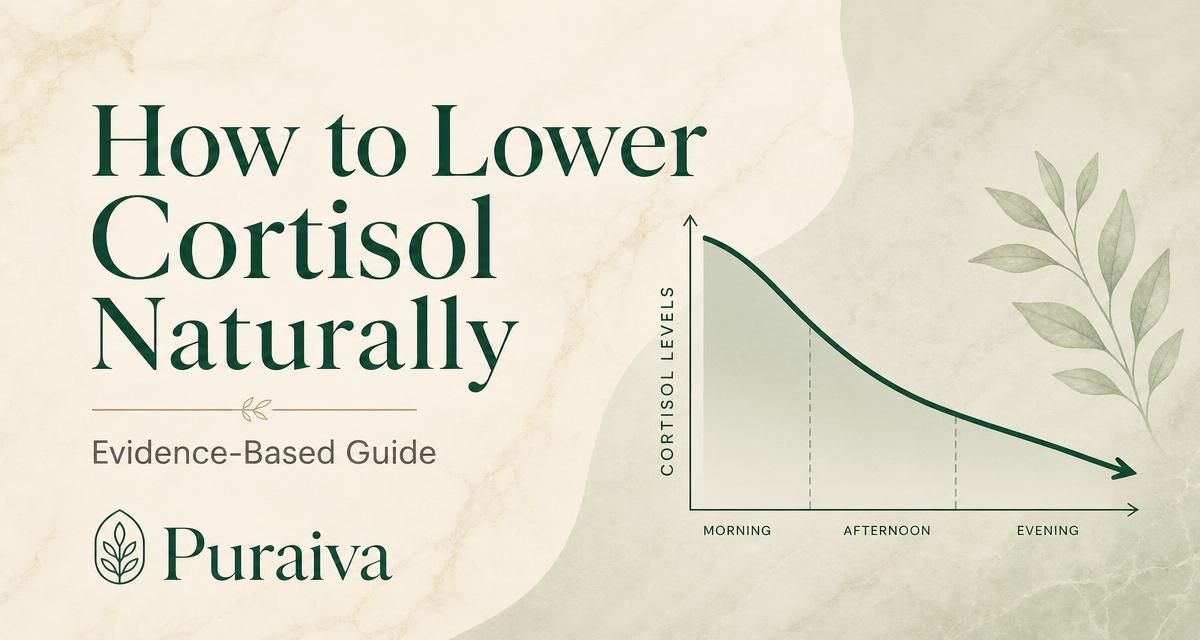
Cortisol isn't the enemy. It's a survival hormone released by your adrenal glands that follows a natural daily curve — high in the morning to wake you up, tapering through the day, and lowest at night so you can sleep. The problem is dysregulation, not cortisol itself. Chronic stress, poor sleep, over-exercising, and blood sugar swings flatten or invert this curve, which is what produces the symptoms most people call "high cortisol."
Signs Your Cortisol Curve Is Off
- Waking up exhausted even after 8 hours in bed
- Second wind of energy at 9–10 PM (inverted cortisol curve)
- 3 AM wake-ups with anxiety or racing thoughts
- Sugar and salt cravings, especially mid-afternoon
- Weight gain around the midsection despite normal eating
- Getting sick easily or wounds healing slowly
- Feeling "wired but tired" — mentally alert, physically drained
Step 1: Stabilize Blood Sugar (The Fastest Cortisol Lever)
Every blood sugar crash triggers a cortisol release — it's how your body pulls glucose back into circulation. If you skip breakfast, chug coffee on an empty stomach, or eat a carb-heavy lunch that leaves you crashing at 3 PM, you're spiking cortisol multiple times per day without realizing it.
The Simple Rule: Protein First, Carbs Second
Aim for 30 grams of protein within 60 minutes of waking. This alone flattens the morning cortisol spike in most people within a week. Pair every meal and snack with protein and fat — never eat carbs alone. A banana becomes a banana with almond butter; toast becomes toast with eggs.
Foods That Actively Lower Cortisol
- Fatty fish (salmon, sardines, mackerel) — omega-3s reduce cortisol response to acute stress by up to 33% in clinical studies
- Dark leafy greens — rich in magnesium, the mineral that regulates the HPA (hypothalamic-pituitary-adrenal) axis
- Berries and citrus — vitamin C directly buffers cortisol production in the adrenal cortex
- Fermented foods (kefir, kimchi, sauerkraut) — the gut-brain axis is a major cortisol regulator
- Dark chocolate (85%+) — 40g daily has been shown to reduce urinary cortisol markers
Foods That Silently Raise Cortisol
- Caffeine on an empty stomach (delay coffee 90 minutes after waking)
- Alcohol within 3 hours of bed — it fragments deep sleep and doubles nighttime cortisol
- Ultra-processed seed oils (inflammation is a cortisol trigger)
- Sugar spikes without protein/fiber buffers
Step 2: Fix the Sleep–Cortisol Loop
Sleep and cortisol are locked in a two-way relationship: high cortisol wrecks sleep, and poor sleep raises next-day cortisol by 37–45%. Breaking this loop is the highest-leverage intervention in this entire guide.
The 9 PM Ritual
Your body needs a clear "day is over" signal 2–3 hours before bed. Dim overhead lights, get off screens or wear blue-light glasses, and drop core body temperature with a warm shower (the post-shower cool-down triggers melatonin release). This alone can shift your cortisol curve within 10 days.
Address 3 AM Wake-Ups Specifically
Waking between 2 and 4 AM is the classic signature of a nighttime cortisol surge — often caused by low blood sugar. A small protein-fat snack before bed (a spoonful of almond butter, a boiled egg, or Greek yogurt) prevents the midnight glucose dip that spikes cortisol. We cover this in detail in our guide on why you keep waking at 3 AM and how to stop it.
Step 3: Breathwork — The Fastest Acute Cortisol Reducer
Nothing lowers cortisol faster than slow, extended exhales. When your exhale is longer than your inhale, you activate the vagus nerve and shift the nervous system from sympathetic ("fight or flight") to parasympathetic ("rest and digest") in under 90 seconds.
The 4-7-8 Pattern
- Inhale through the nose for 4 seconds
- Hold for 7 seconds
- Exhale through the mouth for 8 seconds
- Repeat 4 rounds, 2× per day (morning + before bed)
Do this consistently for 14 days and salivary cortisol at wake-up drops measurably in most people.
The Physiological Sigh
Popularized by Stanford neuroscientist Andrew Huberman: double-inhale through the nose (one long, one short top-up), then one long exhale through the mouth. Studies show 5 minutes daily reduces stress markers more than meditation for the same duration.
Step 4: Move — But Stop Overtraining
Exercise is a double-edged sword for cortisol. Zone 2 cardio (walking, easy cycling, swimming) lowers baseline cortisol. But high-intensity training, especially fasted or late in the day, can push already-elevated cortisol higher and make things worse.
The Cortisol-Friendly Movement Stack
- Morning: 10–20 minute walk in natural sunlight (anchors circadian rhythm and cortisol curve)
- Midday: Strength training 3×/week (short sessions, 30–45 minutes)
- Evening: Yoga, mobility, or a slow walk — never HIIT after 6 PM if you're stressed
Step 5: Supplements That Actually Lower Cortisol (Backed by Evidence)
Diet and lifestyle are the foundation, but specific supplements accelerate the process and correct the deficiencies that keep cortisol stuck high. Here are the ones with the strongest human clinical data.
Magnesium Glycinate — The #1 Cortisol Mineral
Magnesium is a required cofactor for over 300 enzymatic reactions, including the ones that regulate the HPA axis. Chronic stress depletes magnesium (cortisol dumps it in your urine), which then makes your stress response even worse — a vicious cycle.
But not all magnesium is equal. Magnesium Glycinate is the form specifically studied for cortisol regulation because glycine itself is a calming amino acid that crosses the blood-brain barrier. Magnesium Oxide (the cheap form in most grocery-store supplements) is poorly absorbed and mostly acts as a laxative. Magnesium Citrate is decent for constipation but not the best for stress. If you want cortisol reduction and better sleep, Glycinate is the answer.
We break down every form side-by-side in our complete magnesium comparison guide. For most adults with elevated cortisol, 200–400 mg of elemental magnesium as glycinate, taken 60–90 minutes before bed, produces noticeable results within 7–10 nights. Our Magnesium Glycinate formula delivers 275 mg of elemental magnesium from 2,500 mg of chelated glycinate per 3-capsule serving — one form, no oxide filler.
Ashwagandha (KSM-66)
The most-studied adaptogen for cortisol. In a 60-day randomized controlled trial, 600 mg of KSM-66 ashwagandha reduced serum cortisol by 27.9% vs. placebo. It also improved sleep quality and perceived stress scores. Look specifically for the KSM-66 or Sensoril extract on the label — generic ashwagandha powder does not have the same clinical backing.
L-Theanine
An amino acid from green tea that raises alpha brain waves (the "calm alert" state) without sedation. 200 mg reduces cortisol response to acute stressors within 60 minutes. Excellent stacked with caffeine to blunt the cortisol spike from coffee.
Vitamin C
Your adrenal glands hold one of the highest concentrations of vitamin C in your body — they use it to synthesize and regulate cortisol. 1,000 mg daily has been shown to reduce cortisol response to psychological stress and speed recovery.
Rhodiola Rosea
An adaptogen that works within 30–60 minutes of a single dose — useful for acute stress, mental fatigue, and burnout recovery. Look for extracts standardized to 3% rosavins and 1% salidroside.
Step 6: The Micro-Habits That Compound
These take under 5 minutes each but stack into massive cortisol reduction over 30 days:
- Morning sunlight in your eyes within 30 minutes of waking (5–10 minutes, no sunglasses) — this anchors your cortisol curve for the entire day
- Cold exposure — 30–60 second cold shower at the end of your normal shower trains your stress response
- Digital sunset — no phone in bed, no email after 8 PM
- Journaling 3 things at end of day — offloads the mental load that keeps cortisol elevated overnight
- Nasal breathing during workouts — forces you to stay in the zone that lowers cortisol instead of the intensity that raises it
What to Expect: A Realistic Timeline
Cortisol regulation is not overnight, but it's faster than most hormones. Here's what a typical customer following this protocol reports:
- Week 1: Deeper sleep in first 4 hours, fewer 3 AM wake-ups
- Week 2: Steadier energy through the afternoon, fewer cravings
- Week 3–4: Noticeable reduction in belly bloat, calmer baseline mood
- Week 6–8: Cortisol curve normalizes on lab testing (DUTCH or 4-point salivary)
When to Test — and When Not To
If you've been stuck for 8+ weeks with the lifestyle basics in place, a 4-point salivary cortisol test or a DUTCH complete hormone panel tells you exactly where the curve is broken. But don't skip straight to testing — 80% of people don't need labs; they need consistent execution of the fundamentals above. Read our at-home cortisol testing guide for the full breakdown.
Ready to act on this?
Get your personalized cortisol recovery plan
Take the free 2-minute assessment to identify your cortisol archetype, then pair it with the exact magnesium form clinically shown to regulate the HPA axis.
The Bottom Line
Lowering cortisol naturally comes down to five inputs, done consistently: stabilize blood sugar with protein-first meals, protect your sleep window with a 9 PM ritual, use slow-exhale breathwork daily, move without overtraining, and address mineral deficiencies with the right form of magnesium plus one adaptogen. Almost everyone we work with sees measurable results in 4–8 weeks.
If you want the entire protocol laid out as a personalized plan — including which of the four cortisol archetypes you fall into — take our free 3-step Recovery Protocol assessment. You'll get a specific stack based on your symptom pattern rather than a generic one-size-fits-all approach.
Related Deep Dives in the Cortisol Cluster
- The Anti-Cortisol Diet: exactly what to eat (and avoid) to lower stress hormones
- Supplements to Reduce Cortisol: the evidence-based stack that actually works
- Cortisol and Sleep: how stress hormones wreck recovery (and how to fix it)
This article is for educational purposes only and is not medical advice. Consult your healthcare provider before starting any new supplement, especially if you take prescription medication or have a diagnosed condition. Statements have not been evaluated by the FDA.